
I Don’t Envy You
There’s a logical flaw in wanting what others have.

It sure seemed like every Monday of my first season of outdoor track entailed doing ten quarters with a quarter jog.1 That meant ten instances of watching future 2:17 marathoner (and, more important, future Terse Bloviation subscriber) Chris Chattin pull away in the first turn, and nine instances of rushing a bit on the recovery lap to catch him so that we could start the next rep together and I could try to finish that one no farther behind than I had the previous one.
This was an early demonstration of my expertise at watching myself watch myself when I should be fully focused on the task at hand. In this case, the meta-observation centered on noticing how much attention I was paying to Chris’s legs as he immediately gapped me. Chris and I wouldn’t be in human anatomy class together until senior year, but I had read enough encylcopedias2 to come upon human anatomy diagrams. And, at least from the posterior view, that’s what I was seeing. Somehow, in his first year of running, and despite the obligatory waifish upper body, Chris had the lower-body definition and muscularity of a seasoned pro. I envied Chris’s legs.3
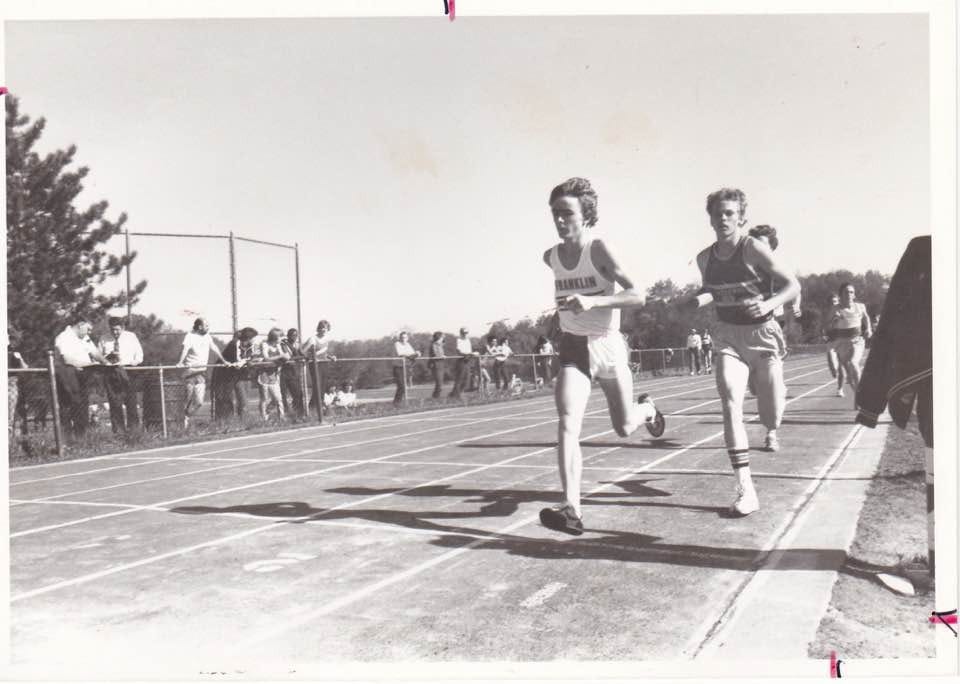
Envying others’ physical attributes wasn’t new to me. In junior high4, the main target was a couple of my fellow drummers. Thanks to a childhood regularly punctuated by brain injuries,5 I’m slow and clumsy. You know those people—usually pudgy, youngish guys—who have one lower leg nervously rapid-firing up and down when they’re sitting in a restaurant or airport? I’m at no risk of developing that nervous habit, for the simple reason that I can’t do it. Similarly, as a drummer, I could immediately nail a song’s beat and rhythm, I could memorize a song after one or two listens, and I had an inherent sense for song structure—I could just feel, say, a 16-bar section and where we were within it rather than having to count it out. But above a certain fairly pedestrian tempo, I couldn’t play any faster.6 Others could, with ease, and I envied them.
The Real Problem With Envy
Envy is said to be the only of the seven deadly sins that doesn’t bring temporary pleasure. That’s a good enough reason to avoid it. What’s the point of pining for what others have if you don’t get at least a little satisfaction? Have you ever really felt better after thinking, “If only I had her money” (or looks, or brains, or hamstrings, or whatever)? Envy distracts and detracts, keeping us from appreciating what we do have and fueling a false narrative that this thing or trait or accomplishment will improve our baseline happiness.
What I haven’t seen remarked on is that envy is illogical.
No part of someone’s life exists in isolation. If my 10th grade wish had been fulfilled, and my legs were suddenly rippling with Chattinesque muscle fibers, I wouldn’t have simply been me + future 2:17 marathon legs. I don’t know how exactly things would have been different, but that’s kind of the point. Who besides Chris Chattin knows what it’s like to run with his legs? Maybe I would have been slower. Maybe his sensory experience of running is different from mine, and I might have been faster but simply enjoyed it less. And maybe, just maybe, I would now, like Chris, have uncooperative knees and not be able to run much.
You can run the same mental experiments for straightness of teeth or facial symmetry or drawing ability or not having acrophobia or speed of Bonham triplets or anything. Whatever body, brain, or body/brain elements that lead to someone being notable in that trait will have other ramifications that might also be nice to have, or might really suck to have. Who knows?
The same goes for envying someone for non-body attributes, the most obvious being money. You + Person X’s money wouldn’t result in the same you but with more resources. Maybe having that money would lower your drive, and maybe your pluckiness is something you’ve always been rightfully proud of. Maybe you would find yourself worrying more, not less, about money, as you focus more on keeping what you now have and you spend lots of time with accountants and financial planners. Maybe you would lose a wider perspective on others’ struggles, or your friends would treat you differently, or you would find yourself saying things like, “A million dollars isn’t what it used to be.” And maybe you would find that the things that bother you most in life aren’t financially based. Again, who knows?
The Perfect Dog
These musings relate to a recent discussion Clayton Young and I had about whether it’s possible to run the perfect race, which led to talking about the idea of perfection in general.7
I have a nominalist view of reality, which refutes Plato’s idea of noncorporeal objects that real objects are inferior representations of. I offered as an example the well-known fact that Peanut is the perfect dog. It would be nice, of course, if she didn’t eat other dogs’ frozen poop and didn’t shift around constantly on family canoe outings. Not shedding all over the house would also be good. But whatever admixture of physiology and psychology results in those few undesirable things probably also contributes to lots of great things. As with envying one isolated aspect of someone else’s life, if you change that mix, you have a different, probably not as awesome, dog.

This view isn’t one of resignation, or of equating perfection with a Panglossian “this is the best of all possible worlds” default.8 Rather, saying “Peanut is the perfect dog” means that, in this world, I’m not going to find a better dog to live with. There are probably other dogs who would be equally awesome. And the perfect dog for me might not be the perfect dog for you, just like the Saucony Endorphin Speed 5 seems like the perfect running shoe for me right now, but might not be for you, and maybe wouldn’t have been for me if it had come out five years ago. But there’s no abstract Perfect Dog, of which all real dogs are just inferior samples.
Letting go of the concept of an ideal dog, or partner, or job should lead to greater appreciation for and enjoyment of your potentially unsurpassable dog or partner or job. (Okay, nearly all jobs suck. We’re speaking theoretically here.) Twilight Zone fans will remember the episode where everything being exactly how you want it all the time turned out to mean being in hell, not heaven.
Careful readers might note that this is all related to an earlier post about the liberation that comes from escaping weltschmerz, or ruminating on the gap between how the world is and how you would like it be. Let’s call being envious of others and/or letting the nonexistent “perfect” be the enemy of the awesome kindischeichtaufdierealität, or childish view of reality.9 Some of the tips from the original weltschmerz post are helpful here as well. If after trying them you find yourself still hampered by kindischeichtaufdierealität, then I definitely don’t envy you.
Yes, quarters, not 400s. We’re talking 1980; our high school track was constructed imperially. (By the way, if Substack’s CMS allowed it, I would go all David Foster Wallace here and make a footnote to this footnote to warn you I’m in an especially discursive mood, so this post will feature more footnotes than usual.)
Speaking of Substack’s CMS, this is interesting: It flags, via the squiggly red underlining, “encyclopedias” as a misspelling, which likely says more about the coders’ ages than about my spelling. (Then again, it also red squiggles “Substack,” so maybe there are no grand conclusions to draw here.)
Gore Vidal liked to quip that if you get nothing else out of War and Peace, at least there’s Tolstoy’s recipe for strawberry jam. So three cheers to Cathleen Schine’s mostly meh novel The Grammarians for providing a quick, useful differentiator between envy and jealousy. Envy is wanting something that somebody else has. Jealousy is the fear that someone will deprive you of something you already have. Throughout high school, I was envious of Chris Chattin’s running talent. At the beginning of 11th grade, I was also jealous of his talent, because after I beat him in the first cross country meet of the season, he resumed beating me, even though I’d run more than 900 miles over the summer compared to his 100ish.
That’s right, this was so long ago that it was called junior high, not middle school. Our high school was just 10th through 12th grade.
Two concussions in elementary school to complement the fractured skull I enjoyed as a 1-year-old.
On the plus side, I would excel in a Low cover band.
Okay, so maybe it’s not just today that I’m in a discursive mood.
“What about your cat?,” Clayton asked. “Oh, no, he’s far from perfect,” I said. “I had the perfect cat from 1995 to 2012.” That was Miss Hitty, seen below in her full glory.

Leave a comment if you’d like me to make up a long German word for some phenomenon. My favorite creation so far is schlechteshaarbearbeiten, literally “bad hair edit” for when your hair is acting up and you try to improve it (recomb, wet it, etc.), but doing so makes it worse.
No German words here but Miss Hitty is an absolute queen in this photo. Seeing Peanut made me smile instantly as well.
Unrelatedly, my 7-9th grade years were also spent in junior high school. I had no idea this was an indicator of one’s age.